AI for HVAC and Plumbing Companies
How AI really works for installation and maintenance companies: from WhatsApp voice notes to a finished job report, with concrete examples, real limits and FAQ.

AI for HVAC and plumbing companies today mostly does one very specific job: it turns what a technician says out loud or photographs on site into a structured document - a job report, a delivery note, a certificate of conformity - without anyone retyping it by hand back at the office. It isn't predictive maintenance, and it isn't an algorithm that replaces the technician: it's a layer of automation applied to the exact spot where installation and maintenance companies lose the most time - job-site paperwork.
In this guide you'll see what AI actually does inside field-service software, how the voice-to-WhatsApp-to-job-report mechanism some tools (Clemp included) use today really works, what its real limits are, and how it differs from other forms of AI you hear about in the industry (predictive maintenance, digital twins) that solve a different problem.
What artificial intelligence applied to field-service software actually is
It's a software layer that reads unstructured input - audio, photos, free text - and turns it into structured data inside your management software, without a person copying it in by hand. In traditional software, the technician fills in a form with fixed fields (customer, job type, materials, hours); with AI, the technician can instead describe the job in their own words, and the system recognizes the fields the software expects inside that description.
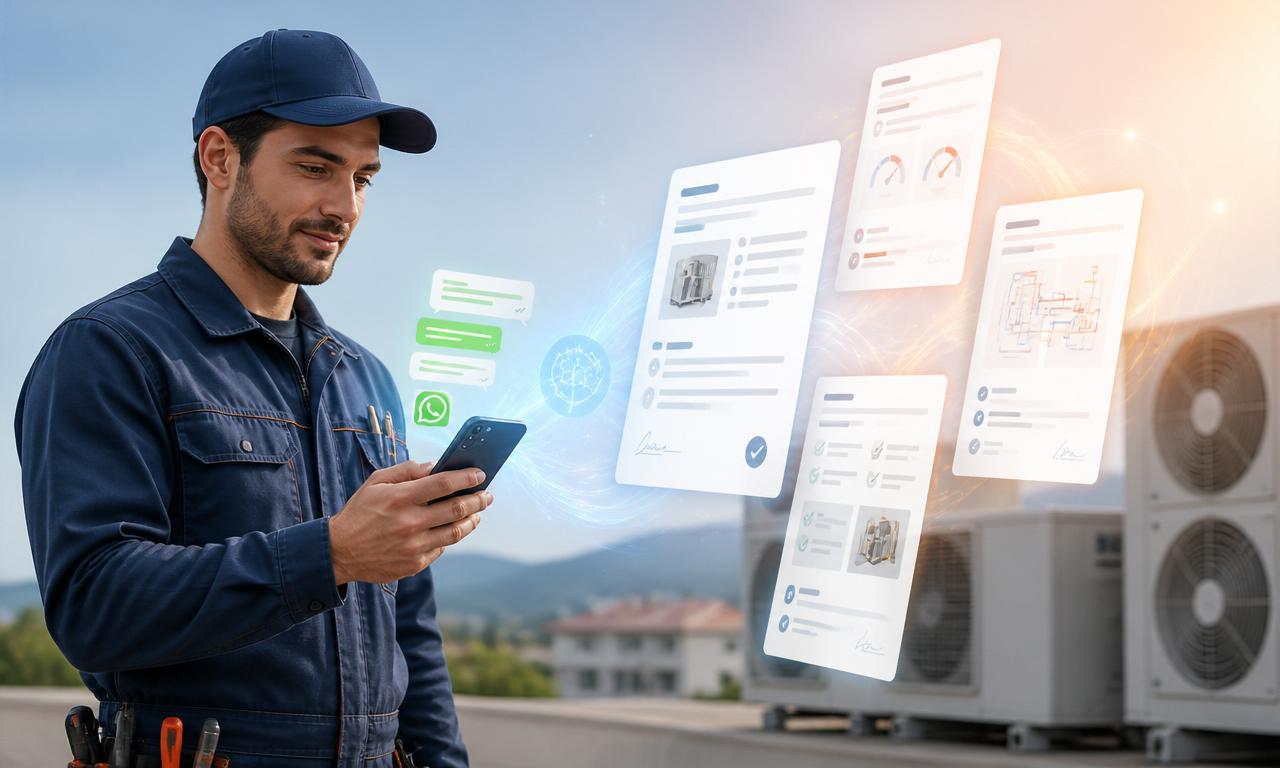
The most mature use case in the trades today is generating job reports from WhatsApp voice messages: the technician records a voice note describing the work the way they'd explain it to a colleague, and the AI extracts the customer, job type, materials used and hours worked, assembling a draft report ready to be checked and signed. It's the same principle that lets a photo of a boiler's data plate be read automatically for model and serial number, instead of typing them in by hand.
A common mistake is thinking this AI replaces the management software or makes decisions on someone's behalf: it doesn't sign anything, it doesn't issue final documents, and every draft it generates still has to be checked by a person before becoming an official document (a certificate of conformity, a delivery note, an invoice). The AI's job is to cut down transcription time, not to remove human oversight of the result.
Who it's for: which installation and maintenance companies actually benefit
The companies that benefit most are the ones with technicians spread across a territory, repeated jobs every day, and a back office that currently spends hours copying information gathered on site. That's the typical profile of plumbing and heating, HVAC, heat pumps, fire protection and pool maintenance companies: businesses with many short jobs (service calls, scheduled maintenance, small repairs) rather than a few long-running projects.
The benefit is less obvious for a company running a single job site at a time with an already organized paper trail: in that case the time saved on transcription matters less against total hours worked. The most reliable signal for deciding whether it's worth it is simple: if someone in the office regularly spends evenings or weekends "tidying up" handwritten reports or voice notes scattered across WhatsApp, the problem this AI solves already exists in your company.
How it works in practice: from WhatsApp voice note to job report
The mechanism relies on three steps, and it doesn't require the technician to learn any new tool because it uses a channel they already know.
- The technician records a voice note on WhatsApp, on site, right after finishing the job, describing what they did the way they'd tell a colleague - customer, problem found, work carried out, materials used, hours spent. No fields to fill in with gloves on, no app to open.
- They attach the relevant photos: the boiler or outdoor unit's data plate, an error code on a display, the finished work. The system automatically links the photos to the correct job, reading data such as model and serial number where the photo makes them legible.
- The AI drafts the job report: it extracts the fields the software expects (customer, job type, materials, hours) from the voice note and structures them into a document. Back at the office, or the technician directly, checks the draft, corrects it if needed, and signs it.
The technical point to understand is that the AI works on natural language, not on a form: the technician doesn't have to mentally break the voice note into separate fields, they can simply describe the job in whatever order feels natural, and the AI will recognize where each piece of information belongs. That's why the mechanism works better by voice than by written text: dictating a 30-40 second voice note on site costs far less time than typing the same content on a keyboard with dirty hands or gloves on.
What it does NOT do (yet): the real limits
AI applied to job reports doesn't eliminate human oversight completely, and anyone presenting it as "full automation" is oversimplifying. Three concrete limits worth knowing before adopting it:
- It doesn't sign official documents on the technician's behalf. A certificate of conformity, a delivery note or an invoice remain acts that require human review and a human signature: the AI prepares the draft, not the final document.
- Extraction quality depends on voice-note quality. Heavy background noise, strong regional accents or fragmented sentences can produce a draft that takes longer to correct than it would have saved - it's not a foolproof system, it's a tool that reduces the average workload, not one that always eliminates it.
- It doesn't replace your management software, it feeds it. You still need a downstream system to handle customer records, inventory, invoicing and regulatory deadlines (F-Gas, compliance certificates): the AI speeds up data entry, not data management.
Predictive AI, digital twins and AI on job reports: not the same thing
Searching for "AI for installation companies" often turns up content about predictive maintenance and digital twins - systems that analyze historical data or IoT sensors on an already installed system to anticipate failures before they happen. That's a real application of AI in the industry, but it solves a different problem: optimizing how a system runs over time, not speeding up the documentation of the people who install or maintain it.
For a small or medium installation and maintenance company, the most concrete day-to-day problem is rarely the lack of predictive sensors: it's the time lost every evening transcribing job reports, copying data between the job site and the office, and chasing regulatory deadlines (compliance certificates, F-Gas register) on spreadsheets or software that the technician on site doesn't use because it's too slow to fill in on the spot. That's where AI applied to documentation - voice and photos becoming a job report - delivers a measurable benefit from the very first month, while predictive maintenance requires investment in sensors and a historical data baseline that few small installation businesses have today.
What you need to start using it in your company
You don't need an IT project or technician training: the only technical requirement is a smartphone with WhatsApp, which in practice every field technician already has. The real step is organizational rather than technological: agreeing with the team on what should always appear in a voice note (customer, job type, materials, hours) so the generated draft is already nearly complete, instead of letting everyone describe the job too differently from one day to the next.
In practice, companies adopting this mechanism almost always start with a short onboarding period - a few days - during which the office checks every generated draft more closely than usual, to spot where the AI needs systematic corrections (e.g. a supplier's name that keeps being transcribed wrong) and fix the configuration once, instead of correcting the same mistake report after report. After this initial phase, review time drops sharply.
Frequently asked questions about AI for installation companies
Does AI replace the technician or the management software? No. The AI turns voice notes and photos into drafts of structured documents, but it never signs or issues anything official: review and signature always remain with an authorized person. The management software remains the system that handles customer records, inventory, invoicing and deadlines.
How does voice-based job report generation work? The technician records a WhatsApp voice note describing the job the way they'd tell a colleague; the AI recognizes the data the software expects inside that description (customer, job, materials, hours) and puts together a draft report ready for review.
Do you need fast internet or a dedicated app to use it? Not with the WhatsApp-based mechanism: the technician's normal mobile data connection and the WhatsApp app they already have installed are enough, with no extra software to download on site.
Does the AI understand technical terms and regional accents used by field technicians? In general it recognizes the industry's technical language well (component names, common abbreviations), but a very noisy recording or strongly accented speech can require more manual corrections on the generated draft: extraction quality depends on the quality of the original voice note.
What's the difference between this AI and predictive maintenance? They're two different applications: this AI speeds up the documentation of jobs that have already happened (reports, delivery notes), while predictive maintenance analyzes historical data or sensors to anticipate a future failure on a system in operation. They solve different problems and aren't alternatives to each other.
Is it safe to send photos and voice notes with customer data over WhatsApp? The channel used to record the voice note and photos is WhatsApp, but the data processed by the AI and stored as a job report stays in the management software, not on WhatsApp: always check with your specific provider how personal data is handled and retained, in line with GDPR.
In conclusion
AI for installation and maintenance companies, in its most concrete application today, is neither predictive maintenance nor an algorithm that decides on the technician's behalf: it's a way to get an already-structured job report into the office within minutes, starting from a voice note recorded on site. It's exactly the mechanism Clemp is built on: the technician sends a voice note and a few photos on WhatsApp, with no app to install, and the office receives an already-filled-in draft report - customer, job, materials, hours - ready to be checked and signed. To understand the full flow, from voice note to signed report, see the dedicated page on WhatsApp job reports.
Want to see it on your own workflow?
Free 6-week pilot with your technicians. Reply within 24 hours.